
| Louise Erdrich explores mysteries and miracles on the reservation | |
| by Alden Mudge | |
From  |
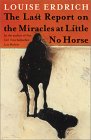
 When Louise Erdrich finished writing The Last Report on the Miracles at Little No Horse, she went back and read through the works of William Faulkner. "I do that every so often," Erdrich says during a call to her home in Minnesota. "And I always dip into Proust. And then I dip out of Proust."
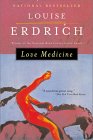
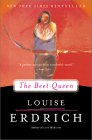
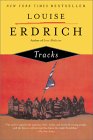
 This makes sense, in a literary sort of way. To immerse oneself in the most luminous of the novels in Erdrich's Dakota cycle -- Love Medicine (1984), The Beet Queen (1986), Tracks (1988) and, now, The Last Report on the Miracles at Little No Horse -- is, in some ways, to plunge into a Proustian stream, where time flows backward as easily as it flows forward. Even more to the point, over the years, any number of reviewers have seen parallels between Erdrich's creation in novel after novel of a mythical Ojibwe Indian reservation and its environs near the Minnesota-North Dakota border, and Faulkner's creation of his fictional Yoknapatawpha County, Mississippi.
 "I've finally figured out that I'm just working on one long novel," Erdrich says in response to a question about the layers of legend and meaning that accumulate with each new novel. "I think it is useful to have read the other books. But I try very hard to make each book its own book. It is its own book. But they all connect in some way."
 Those connections are strong in The Last Report. Ostensibly, the action of the novel revolves around the investigation of the possible sainthood of Sister Leopolda, who had been a nun at the reservation mission. Leopolda has been credited with a host of miracles and the Vatican has sent a priest to conduct the inquiry into these claims. Among the skeptics is ancient Father Damien Modeste, who has quietly ministered to the spiritual needs of the reservation's inhabitants for more than 80 years. Through this priest's memories, we see a number of the familiar events and characters from prior books, but in a new light. More importantly, we see Father Damien, who has been more or less part of the background in the previous books. In fact, The Last Report becomes the story of Father Damien, and Erdrich tells this story with the same immensely satisfying mix of humor and pathos, legend and dream, wisdom and poetry that typifies the best of her novels.
According to Erdrich, The Last Report was one of the hardest novels she has ever written. First, it presented the usual problem of keeping characters and events consistent with the earlier novels ("I have a wonderful editor named Trent Duffy. When the manuscript first goes to him, I've always made some major error, usually having to do with who was around when and what they were doing. He keeps a file on every character and he's got a very sharp eye."). Second, her ambitions for the book were large. "I wanted it to be written at the level of a poem. And yet I wanted it to be coherent and have the complexity that it needed. It was hard for me to get there. I threw out huge amounts of paper. I kept the recyclers in business. I think coming to terms with the subject was difficult. And finding out how to end it was hard, too."
 Despite difficulties with the composition of this novel, little seems to keep Erdrich from tapping into an incredibly rich river of story. After growing up in North Dakota where her German-American father and Ojibwe mother taught at a Bureau of Indian Affairs school, Erdrich went east to attend Dartmouth. She was just 28 when Love Medicine was published; the book became a surprise bestseller and captured the National Book Critics Circle Award as best work of fiction. Not even the devastating suicide in 1997 of her former husband and long-time collaborator, Michael Dorris, seems to have dammed her creative flow. Since then she has published two novels, a children's book, short stories and poems. She has also rebuilt her life and opened a bookstore with her sister. As we converse by phone, she coddles the newest addition to her family, a four-month-old baby.
 But Erdrich's concern at the moment is how The Last Report is understood. In the novel's first chapter a young woman named Agnes DeWitt encounters Father Damien, a Catholic priest en route to an Indian mission. When he drowns in a flood, Agnes has a direct experience of God and decides to assume the priest's identity. The fact that Father Damien is actually a woman in disguise will surprise readers of Erdrich's earlier work.
"I didn't want [the book] just to be about this revelation that this priest was a woman," Erdrich says. "That really wasn't the point of it. That's why from the first chapter, this is not a secret from the reader. I don't want the book to be about gender politics or even about church politics. That's in there, of course. It's implicit in choosing what the book would be about. But I most wanted it to be about this very human choice that she made and how that choice shaped a life. I also wanted it to be about a priest who is in many ways converted by those who he/she has come to convert."
The character thinks and behaves as Father Damien during the day and in public and as Agnes in private and at night. Erdrich says she developed a set of rules to determine when the character would react as Agnes and when he would react as Father Damien, not merely as a mechanical exercise but to further her exploration of the complexity of human identity. "That is a consistent question for me," she says. "I like addressing the mystery of identity, probably because I have a variety of identities of my own."
 Erdrich says the question of Father Damien's identity evolved as she wrote the book. "I wrote the first chapter and I really didn't know until writing the very end of the chapter that this priest was a woman," she says. "It was one of those situations where a character surprises you. When I went back to look at the description of Father Damien in Tracks, I realized that I had really written a rather gender neutral person and that this was somehow there all along. These books have really always come up with surprises for me, yet when I have found out something new about a character, it has almost always been consistent with previous descriptions. So it seems to me there is some unity that underlies it all that I am capable of somehow tapping into."
 Agnes/Father Damien eventually abandons rigid church dogma and dispenses love and forgiveness to all comers. In a mysterious and moving scene near the end of the novel, Agnes/ Father Damien at least temporarily defeats Death, who comes to her in her sleep, by recalling all the people she/he has been able to forgive since coming to the reservation.
"Most of my books are about revenge," Erdrich says. "So it's interesting to write forgiveness into a book. I think forgiveness is a lot tougher than I've had the grace to understand."
Alden Mudge writes from Oakland, California.
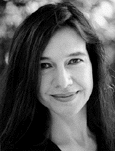
Author photo by Marc Norberg.
Louise Erdrich has written novels, nonfiction, poetry, and children's books. She has received many awards for her writing, including the Academy of American Poets Prize in 1975; the Nelson Algren Fiction Award for "The World's Greatest Fishermen" and the National Endowment for the Arts Fellowship in 1982; a Guggenheim fellowship, the Los Angeles Times Award for fiction, the O. Henry Prize and National Magazine Award in 1987, the Western Literary Association Award in 1992, and the World Fantasy Award for The Antelope's Wife in 1999.