
Jasper Fforde
Interview by Ron Hogan
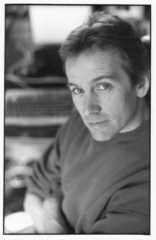 Jasper Fforde spent several years as a focus puller on big-budget Hollywood productions like the James Bond film "Goldeneye," but in the early 1990s, he began to spend much of his free time writing -- first short stories, then novels. His first published novel, The Eyre Affair, is a wildly inventive caper set in an alternate universe where SpecOps literary detective Thursday Next must thwart the plans of Acheron Hades, the third most evil being in the world, use an invention that enables people to literally enter into worlds of fiction -- stolen, as it happens, from another member of Thursday's eccentric family -- and kidnap Jane Eyre from the original manuscript of the classic novel, thereby eliminating her from the story altogether.
Ron Hogan: What was the first thing to set The Eyre Affair in motion?
Jasper Fforde: It originally started as a film script, before I ever thought I could write a novel at all. It wasn't very good, but it had Thursday Next in it, and her assistant, and the idea that somebody had kidnapped Jane Eyre. It wasn't a very good film script, as I said, and not all that funny, very serious and dark. I realized that the characters were awful and it just didn't work, so I put the script aside and started writing short stories to try to flesh out a story and a character for the script. There's a great film written by Graham Greene, The Third Man, where he'd written a short story essentially as a treatment for the film, and I figured, well, if it's good enough for Greene, it's good enough for me. So that's what I did, and then I found out it was more fun to write the short stories, and then I started writing longer stories, and I eventually wrote two novels which were rejected completely. At that point, I went back to The Eyre Affair and started imagining it as a novel.
It's so richly detailed in its final form that it seems like it would be almost impossible to do it justice in a film version, because you've created such a different world.
 I was writing the story, with Thursday and Bowden and Jane Eyre, and to make it work, I needed a world in which literary things were that much more important. I was finding out that it really didn't fit into our world at all, which is where I'd first set the story. Rather than make the plot fit our world, I decided to make her world fit the plot. As soon as I started doing that, and I had that blank canvas to work with, that's when all sorts of ideas came out, because now I could do anything.
What inspires certain twists, like the Crimean War still going on 150 years later, or Wales becoming a socialist republic?
The way I write is that the book tends to evolve, and one big idea will beget many other little ideas, which give birth to other ideas. I happened to be reading a book about the Crimean War at the time, and thought it would be interesting to have it still being fought, to have this long, dull war of attrition. And then I thought that if the war was still going on, Russia might not have become a socialist republic, so what happened to Lenin? I knew he'd visited London at one point, so maybe he met a Welsh girl, fell in love, and went back to Wales with her.... Things just start building on each other, and I take the ideas to their logical conclusion. That's the thing: no matter how bizarre the ideas are, if there's a logical framework to hang the story, it can all make sense.
Your police group, SpecOps, provides room for any number of stories. This one's about literary detectives, but we see glimpses of the vampire hunters and time travelers...
As soon as I realized that Thursday worked for a government agency, instead of as a freelance literary detective as I originally imagined her, I figured out that her world is a bit of a police state where everything is regulated and under surveillance. So I started creating divisions of the police agency, and there's a lot of scope for all kinds of wacky adventures, not necessarily with her, but with other people. And certainly the fact that she doesn't want to be stuck in her division forever opens things up...
The Eyre Affair was originally supposed to be one book. Then when the UK publishers bought it, they asked me if I could do two, so I said, "Sure, great!" and pretended that was the plan all along. So I wrote Lost in a Good Book, and now they want another two. So the series can go on, and I certainly haven't run out of ideas for what could happen. If I ever do get bored with writing about going into other books, I can just move to another division of SpecOps and do something there.
After writing what you'd planned as a single book, did you have to figure out how to bring Acheron Hades back for the sequel?
 Oh, no, he's dead. But he's only the third most evil person in the world, so there's other baddies around... I think it's safe to reveal that in the second book, Thursday discovers that the literary police doesn't just exist in the outside world; it turns out that there's a police force inside the books as well, looking after the narrative from within. She's inducted into this force, JurisFiction, and she's under the wing of Miss Havisham from Great Expectations.
I didn't want Thursday to just go into another book and change it; that would be too much like the first book for me. It's too boring for me, and I'm sure it's boring for the audience. So I want to explore some new ideas, raise new question marks for the readers that I can spend the series answering.
I haven't actually started book three yet, but I'm definitely thinking about it. There's a lot of threads to pick up after book two. I'd written 100,000 words and the story wasn't nearly finished, so I knew I'd have to carry some of that over into book three. There are all sorts of areas I haven't explored yet about holding a book together from within, and the kinds of things that can go wrong.
The book reflects an obvious love for books...
 Stories, really, I think. People always exclaim about how well read I must be, and I think it's that I love stories, because there's a lot about film in there as well. I wouldn't like to be thought of as a literary expert; I have no training in literature at all. The really fun thing is that when I decide to write about Jane Eyre, or about Trollope, I then have to go read the books I'm going to steal stuff from. Underneath the guise of research, I get to pull up on the couch with great books.
Your tastes are pretty diverse. This novel alone has you using elements from Dickens and Austen, but also from science fiction and fantasy.
I'm not really a major science fiction fan. I haven't read much contemporary science fiction at all. I loved all the H. G. Wells and Jules Verne, the classic stories, and a book I read years ago by Alfred Bester, called Tiger, Tiger. I remember reading it in 1976 and being totally bowled over. I think the science fiction reviewers have actually been rather sniffy about my book, thinking that I've just stolen stuff from everybody.
I have read Douglas Adams, of course. He's fantastic. The radio show [of Hitchhiker's Guide to the Galaxy] came on just as I was leaving high school, and it was so inventive. That's what I liked about it more than anything else; the ornaments he hangs on the story are just so, so delightful. Things like the babel fish, wonderful little zingers. And I tried to come up with similar little bits of brain food for my book, like the translating carbon paper which is sort of a direct response to the babel fish, a translator for the written word like the babel fish was for the spoken word.
If you could step into any book, where would you go?
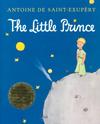 I guess I could go into one of my books and meet the characters, tell them, "Hi, I'm Jasper! I wrote you!" Then they'd ask, "Well, couldn't you have written me a little more handsome?" Then I'd try to apologize, and everybody would start complaining about the mole on their face, or how old they are.... I don't know. Favorite books, I suppose, like The Little Prince. That'd be fun... That's a good question. I'll have to think up a better answer to have ready if somebody asks me that again.
Ron Hogan is the editor and publisher of Beatrice.com, a collection of interviews with authors of contemporary literary fiction and nonfiction.