
| Gershom Gorenberg | |
| Interview by Gavin J. Grant |
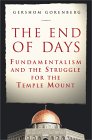 Gershom Gorenberg has lived in Jerusalem for the last 23 years. We talked by phone about his nonfiction book, The End of Days, the complexity of writing about the Middle East for the American reader, and about how the heart of the problem involves the clash of different stories.
How did you come to live in Israel?
I grew up in California and I came [to Israel] to study in 1977 -- I ended up staying and going to graduate school here, and beginning to work as a journalist, which I've done for the last 17 years. I'm a citizen of both countries and, for writing a book like this, that's very helpful because I'm writing about something I'm extremely familiar with. I'm also writing for an audience in the country I grew up in and I'm still very connected to. I think in both languages, as it were.
It must be hard to report on such a complex subject.
That's always the challenge, to strive to be as accurate as possible, but also to keep the American reader -- who's at a great remove -- in mind. Not just in terms of language, but also in terms of the process: It's an act of translation. Like any translation, you have to be accurate to the original but also make sense in the translation. What I was seeking to do in the book was to provide a map, a guided tour, a codebook to an aspect of the Middle East crisis that has been the least understood but has an immensely powerful influence.
The Temple Mount does not come up in the news very often.
In the last few months, it has -- from the Camp David negotiations through Ariel Sharon's visit to the mount, and the beginning of the current uprising, people found themselves suddenly hearing about this subject. I don't think a lot of sense has been made in the daily news coverage out of why this little piece of real estate would cause this great big crisis.
I gave a copy of the pre-publication galley to one Western diplomat and, after reading it, he said, "Wow. Now I see why they left the Jerusalem issue to the end of the negotiations." I guess there are a lot of people who wish they could have left it a little bit longer! I hope I've succeeded in making sense of why this issue, and particularly the issue of one holy site, could have such an explosive influence -- and in my opinion, has really had that influence over and over again in the history of the conflict.
Can you explain in simple terms what it is about the Temple Mount that causes this conflict?
The Temple Mount is essential to the history and religious and national aspirations of each side. It's an embodiment of visions that are part of the identity of each side in the conflict, and that creates a zero-sum game: if one side has [the Temple Mount], that's unbearable for the other side. So it has become an extremely difficult issue.
The basic idea I work from is that you have to take the stories and the beliefs of people very seriously, even if you don't share them. Particularly when you are dealing with the Holy Land, where the whole reason people care about this place is religion, and essentially the stories religion tells about the past and the future. You have to take those beliefs, even if you don't share them, as strategic facts.
The Temple Mount is the holiest place in Judaism: It's the place where the temple stood in ancient times, it's the place to which Jews turn when they pray. But more than that, it's the place where, according to Jewish tradition, Abraham nearly sacrificed Isaac -- a founding event in Judaism. And, it's the place where, according to Jewish tradition, the temple will stand again at the end of history.
On the Muslim side, it's the place where Muhammad -- the founder of the faith -- ascended to heaven and literally met God, and it's also the place of final judgment. This is where history essentially begins and ends. What's even more amazing about this story is that, for a very large number of fundamentalist Christians in the USA and around the world, it's also a place that is crucial to the fulfillment of prophecy and the end of history. So you get this religious triangle, where all three faiths, or at least elements of all three faiths, see this spot as essential to their dreams -- and are obsessed with it. One of the things that does is create a situation where any small action by one person reverberates incredibly and has an immense emotional effect on members of the other side.
Which is why, from the Camp David [negotiations] and Sharon's visit onward, I had that feeling of standing on the sidewalk watching somebody driving a truck straight toward a wall. You keep screaming, "Brakes! Brakes!" but they don't hear you. Something as simple as a visit to the site by a politician intensely disliked on one side was enough to set off a conflagration. It didn't even require a bomb, just the symbolic action.
In terms of working on the book, I felt I was working on a nonfiction Damascus Gate, and the truth was definitely stranger than fiction. Usually when people have talked or written about a threat, or that the Temple Mount might set off some kind of conflict, they've written about it in terms of kooks or psychiatric cases. This place has immense symbolic importance and attraction to people who are quite sane, and sometimes to people who are part of the mainstream. That actually makes the spot much more of a potential catalyst for a conflict.
So this is all about the importance of storytelling?
In a sense, yes. One of the things I say in the book is the Temple Mount that matters is built out of stories, not out of stones. The stories that people tell about this place are incredibly important. I set out to tell the stories of the people who tell the stories about this place.
When I deal with people who expect the end [of history] and expect the Temple Mount to be center stage for the end, one of the things I found was that the whole way they look at history is as if it's a novel -- with a clear beginning and end, a clear plot, a clear hero, and a clear protagonist. The author, of course, being God. I was writing a story about people who see the whole world as a story.
Do you think this novelistic view is a twentieth century view?
The novel as we know it now may have been invented [recently], but the story wasn't. The story with a clear beginning and end, and even with a plot, certainly wasn't invented [recently]. In some sense the kind of clear wrapping up [of modern novels] has an older brother in the kind of religious tradition that sees the world as beginning and ending at a certain point. If you look at the structure of the Christian Bible as it is currently ordered, it begins with the Book of Genesis, the beginning of the world, and ends with the Book of Revelation, which is the clear, absolute end of the world. So in a strange way, the early Christians who determined the order of the books in the Christian Bible, essentially structured it as a novel -- a novel that they thought was absolutely true. The Book of Revelation is the denouement.
Part of the theme of The End of Days is the fascination with stories and with the stories people tell about history and tell about the future and how those stories have immense power to affect our lives.
Do you think there is any way out of the Middle East crisis?
 That's an open question. I always say that I write about people who engage in prophecy, I don't engage in prophecy myself. Asking whether there's a way out, you risk falling into that trap, because you're making a prediction. I think that the beginning of finding a way out is recognizing that you're dealing not just with practical issues but also with strong beliefs and what's holy to large groups of people. Even if those aren't your beliefs, you have to take them seriously and have respect for them if you're going to begin to look for a way to find a compromise. One thing I suggested in an article I wrote for the Washington Post, (LINK?) when it still seemed like the peace negotiations had a chance, was that one approach to the problem of the Temple Mount is to declare that it's under divine sovereignty. Each side could say, "Of course, it belongs to God." Each would be thinking in terms of their god, but it's a way of avoiding the zero sum problem.
Do you have any book recommendations for people interested in the Middle East?
 I just reviewed Tom Segev's book, One Palestine Complete, which I enjoyed very much. Another book which I think is very good is Yaron Ezrahi's Rubber Bullets, which is several years old. I have to say that when it came to the religious element in the struggle, I found a rather limited selection of books. You could find many religious tracts and books by the players on each side -- in other words, there are lots of books in English about how prophecy is being fulfilled in the Middle East. But books that try and make sense out of that for the outside reader are rare, and they're particularly rare if they're for the general audience and not just for The Journal of Obscure Studies.
Whereas you're trying to introduce this subject to a wider audience.
What I'm trying to do is something that is as serious as what would be done academically. I've gotten very positive responses from academics. My goal is to explain the ideas in a manner that can be read by the intelligent, curious general reader. And I would hope not just a Middle East buff, but also somebody who is interested in contemporary affairs. One thing that came up -- which was very interesting to me as someone who is both American and Israeli -- is that I began to explore the whole religious background to, for instance, the interest of the Christian right in Israel which is very, very intense and which is really part of American politics. Obviously, American politics has an effect on Middle East politics in the clearest possible fashion. I saw myself as exploring a very interesting part of American culture and politics. In a sense we're very familiar with the role of the Christian Right in American domestic policy debates, abortion, prayer in schools, all those things. But when it comes to the Middle East, there's also very clearly a religious foreign policy. That was one of the things that I sought to explicate.
Gershom Gorenberg is a senior editor and columnist for The Jerusalem Report, a regular contributor to The New Republic, and an associate of the Center for Millennial Studies at Boston University. He grew up in California and since 1977 has lived in Jerusalem, where he received his M.A. from Hebrew University. He is married and has three children.