
Tony Horwitz
Interviewed by Andrew Duncan
|
|
|
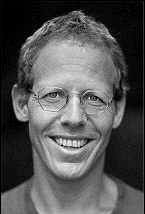
After attending Columbia University's Graduate School of Journalism, Tony Horwitz worked for a decade as an overseas correspondent. During that time, he covered conflicts in the Persian Gulf, Sudan, Lebanon, Bosnia, and Northern Ireland. He was a staff writer for The Wall Street Journal and The New Yorker, and in 1995, was awarded the Pulitzer Prize in Journalism. His other books include One for the Road, and the national bestsellers Baghdad Without a Map and Confederates in the Attic.
|
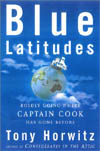
BookSense.com: When doing your research for Blue Latitudes you roamed over most of the South Pacific, went to England and Alaska…how long did it take you to do all of the traveling?
Tony Horwitz: The traveling and the writing together was almost three years. About half of that was the travel component. The rest was in archives or in writing.
You did it piece by piece?
Yeah, I didn't take a continuous journey. What I did do was try to follow Cook's voyages in order. His first voyage he went to Tahiti, New Zealand, and Australia, so I did the same thing.
There was only one trip I had to take out of order. I couldn't go to Alaska in February, so I did that another time.
When you're traveling for research, do you prepare yourself beforehand?
I tend to sort of plunge in and see where it leads me. I think particularly with travel-type books that are focused on discovery, it's a mistake to over-plan. The most interesting things are always the ones you don't expect, and I wanted to experience some of that freshness in discovery that I so envy in Cook. So, while I certainly had a list of places that I wanted to go, I didn't have any kind of detailed plan of what I would do when I got there. I just wanted to immerse myself and see where it led.
I think it's hard to write freshly if you over-prepare for a trip. It's hard to see a place with fresh eyes if you've already visited it so much in books and videos that nothing can surprise you. That's one of the diseases of modern travel: we've been everyplace before we even get there! Obviously that wasn't the case in Cook's time, and we can't duplicate that. However, we can take small measures to try and visit places with open ears and open eyes.
What's the most important aspect of travel to you? What do you like to get out of it?
When I travel for my writing, or when I travel to goof off?
Either way.
 I travel so much for work that I don't do much travel otherwise. I try to avoid it! I'm sort of a homebody when I'm not working. When I'm traveling as part of a writing project…I think meeting people. I'm not somebody who seeks out deep wilderness, for instance. For example, during my travels for Blue Latitudes I never set foot in Antarctica. Partially because Cook never set foot on the continent, but also because it looked like an unpromising destination for the sorts of things that I like to do. I like to meet people and describe human society. You know, I love the woods, I love animals, but I don't know how to interview a penguin. So, I think in that sense I always drift toward people, wherever I go. On my personal travel, less so -- I just lie on the beach with a good book!
Was there something you found while researching Blue Latitudes that surprised you more than anything else?
I guess everything sort of surprised me! Although I think I was most surprised by what I learned about Cook the man. Initially, I was drawn more to his voyages, and the image of myself going to these exotic places. But the deeper I got into it, the more I became obsessed with understanding who Cook was, and what drove a family man in his 40s off the end of the known world three times.
It's amazing that he was able to hold everything together as much as he did, really.
Yeah, exactly. When you think of the hardship and stress of being the captain of an exploring trip in those days, with the disease and the danger and the simple wretchedness of being at sea for three years at a time completely out of contact with home, it's incredible that he held it together as long as he did.
Certainly on the third voyage there was a lot of grumbling, and things did not go well. There was a lot of tension on board his ship, but no mutiny. Ironically, Captain Bligh was under him on the third voyage, and he didn't seem to learn any lessons. But obviously Cook was a remarkable commander who truly understood his men.
What do you think drove Cook?
I think discovery became a drug for him. He writes at one point that, "Were it not for the thrill of discovering even so much as a sand bar, this service would be insupportable." He put up with these incredible rigors, but part of what drove him was this ceaseless curiosity and hunger to find out what was over the next horizon. Then once he got started, he wanted to fill in the entire Pacific, and couldn't bear the idea of others going off in his stead. Eventually, that ambition killed him.
Evidence that Cook carried what you call in the book a "novelty-seeking" gene, maybe?
An archaeologist I met in Alaska told me in scholarly literature that there's discussion of whether there is this "novelty-seeking" gene that leads some people to seek adventure. These were the sort of people who led early man out of Africa, and they've been with us throughout time.
Cook was perhaps that sort of character. He obviously had an astonishing degree of curiosity, particularly when you look at his background. He couldn't have come from a more provincial setting. He was born in a mud hut in rural England, and yet he goes on to explore more of the Earth's surface than anyone in history. You have to wonder what made him that way. First of all, he was obviously a prodigy. He was almost entirely self-taught, but he also obviously possessed a drive to go out there and search the unknown that most of us don't have. As that archaeologist also said to me, Cook would today probably be diagnosed with ADD. He needed fresh territory. He was just innately restless.
 We can also over-think it. Whether it was a gene, or he didn't get along with his wife, or he had a girlfriend in Tahiti…these things we'll never know, and can only speculate on.
What sparked your anthropological interest in Cook's voyages?
The voyages themselves: To me, the most compelling part of Cook's story is the drama of first contact between Europeans and Pacific peoples who have never seen each other before. This is an experience we simply can't have today. It's fascinating for me to read these very vivid accounts of people who shared not a single word in common, knew nothing of each other's culture and customs, but somehow managed to communicate, and, for the most part, get along. I think, while I'm certainly not a trained anthropologist, the book does in a sense become anthropological in the way it looks at indigenous societies and how they were transformed by Cook's arrival.
I'm fascinated by how the past bleeds into the present, and in the Pacific, Cook and his voyages had a very real impact that is still evident today.
In most cases, it seems like it's been difficult for the indigenous Pacific peoples to come to terms with that influence.
One reason I think indigenous people are still often fixated on Cook is that first of all, it wasn't that long ago. It was a little over 200 years ago, so it's a nanosecond in time compared to the thousands of years during which these societies dwelled untouched by the West. And they're still really struggling with the legacy of colonialism and everything that came with it: diseases that ravaged the populations, missionaries who basically extinguished native beliefs, and colonists who changed the environment and made them second-class citizens in most cases. These issues aren't in the remote past, they're still lingering under the impact of Cook's arrival today.
Do you see any solutions to the problem?
One interesting thing I found -- and I talk about it throughout Blue Latitudes -- is that while many people condemn Cook because he was the first one there in many cases, they're also using him as a resource in what's become a sort of cultural renaissance. Through their writing and art, Cook and his men give us the best snapshot we have of what life was like in the Pacific before Europeans came. Many native people are now turning to those records to understand everything from what tattoos looked like, to how their canoes were built, even to what words they spoke and where they lived.
The Maori in New Zealand are even using evidence from Cook's voyages in their land claims against the government. While he was in New Zealand, Cook saw fishing canoes 12 miles off-shore and noted that in his log. Well, Maori are now saying: "Look, that's the extent of our traditional fishing ground. Your own hero wrote it!" So I think Cook is getting a fresh look from many people in the Pacific, and often in a more positive light than has been the case before.
It was interesting to see how polarized the Maori were in their opinions concerning Cook: some held him in high regard, while others were absolutely against anything to do with him.
I found that kind of thing everywhere, where people see in Cook what they want to see. Some turn him into a sort of hero of empire and civilization, and others see him as a monster. I feel that the truth is somewhere in between, and as an American, perhaps I came at his story without the sort of ideological baggage that others carry. Cook isn't a loaded figure for us, so I think I was able to stand to the side, hear both sides, and come to my own judgments about how he should be remembered.
Still, it's incredible in the book how Cook contacts all of these disparate cultures without too much conflict.
 I think it's partly due to Cook's character. His men often write about it in their journals that he just had the "touch." He had a way of putting people at their ease, and he led from the front. He was obviously a brave man and a commanding figure, and somehow he was able to approach Pacific peoples in a way that they generally received him peacefully.
I think it's also a comment on the times, though. They had an openness and curiosity about the rest of the world that's refreshing to read today. We're at a moment in our history where we're fearful of the rest of the world and we're busily sort of barricading ourselves. This was a different era. It was the Enlightenment. There was a kind of idealism that most of us don't feel today; an optimism that they could step off these boats and make peace with people and trade with them and live together. Unfortunately, while Cook was able to achieve that most of the time, those who followed in his wake were often far less humane and skilled with people. So we have to recognize the considerable damage done in his wake.
I realize this is an entirely speculative question, but if Pacific peoples had gone untouched by European exploration, do you think they would be better off?
It's an interesting question, and while researching my book I often talked with Aborigines and Maoris and others about what would've been different if Cook hadn't come. Most of them recognize that somebody would've come, and one: they might've been less gentle figures than Cook. Two: I think for all of us, one bonus of it having been Cook is that he had a ship full of trained observers, botanists, linguists, painters, and writers -- and, on his last voyage, even poets. As a result, we have this very rich record of what life was like at that moment of first European contact. If it had been, say, whaling ships, we simply wouldn't have that trove of writing and artwork and artifacts that Cook and his men brought home. That's precious to all of us. It gives us a way to try and understand what those societies were like, because they did begin to change dramatically almost at first contact.
Was Cook the one who wanted to take observers along?
Initially, no. It was very peculiar. His first voyage was commissioned to be a mainly astronomical mission, so there were astronomers on board. Then, Joseph Banks piggybacks on the trip and came along with his botanists and artists. That expanded the mission. Then, Cook's backers added on a second set of orders, which were to sail from Tahiti onward to see what else was out there. The trip ended up being a much broader voyage of exploration than originally intended, and when it came home successfully, they essentially just followed the same formula on the second voyage.
Cook and Banks make such a nice contrast of personalities in Blue Latitudes.
Yeah, they're really an unlikely partnership in many ways. It made for a stronger union that they had such different, but complementary, talents.
Did Cook enjoy having all those people along?
He certainly enjoyed Joseph Banks. The second and third voyages are more complicated in that regard. Cook got a replacement for Banks at the last minute on the second voyage (a man he didn't get along with), and he allegedly said at one point something along the lines of "damn all scientists." However, Cook himself was an untrained or self-trained scientist. Even though on the third voyage there wasn't a figure like Banks around, there were many well-educated, keen observers on board, and we still get very rich, really raw data about the places they visited.
What do you think happened on that ill-fated third voyage? Cook suddenly seemed to just lose it...
There are all kind of possible explanations, ranging from intestinal obstruction to drug addiction, but I tend to think the likeliest explanation is that Cook was simply burned out. He was 50 years old, which in those days was a very advanced age. He'd been at sea for more than 30 years, and 10 of those were in the Pacific commanding vessels. He'd had almost no break between voyages, and I think the cumulative stress of command finally just broke him.
The third voyage was particularly tough because the mission was futile. He was looking for a navigable northwest passage through the Arctic, and I think he knew after probing the area that he was never going to find it. That certainly compounded his problem.
I also speculated in the book that he was suffering from physical and possibly psychological illness. Cook became an entirely different man than he'd been on the two earlier voyages. He began as a very humane, tolerant, and firm but fair commander, and in the end he became erratic, petty, and, at times, cruel.
Did Cook know before he left on the voyage that he was a little unstable?
 We can't really know what his state of mind was. We have letters and journal entries, but he doesn't tend to dwell on himself. We only catch hints, and can only read between the lines, and read his actions. He became quite ill several times on the second voyage, so I think the physical problems existed by then. At one point, the men on his ship write that they despaired of his life. He had an intestinal problem that's hard to diagnose at this distance with any accuracy, but he had a very severe…some sort of obstruction that may have caused other problems.
Needless to say, the medicine of the day wasn't of much use in treating his ills. In fact, it probably compounded them. We know he was treated with laudanum, which is basically a form of opium, so it's also conceivable that he was battling a drug dependency. Again, there's no hard evidence of that, but there's a range of possible physical explanations for his collapse. We simply can't know for sure.
The actual incident that leads to Cook's death is so bizarre.
I would say Cook's death is probably at once the best known, most written about, and least understood aspects of his entire career. There are so many question marks about how the Hawaiians saw him. If they saw him as a god, why did they kill him? Why did Cook do what he did and essentially provoke a skirmish that resulted in his death? We don't even know for sure what happened exactly! We have multiple witnesses with contradictory accounts, many of them trying to protect their own reputation -- no one wanted to be blamed for Cook's death.
To this day, Cook's death is still a mystery, and that's part of what makes it so fascinating. What really seals the mystery is that Cook, this faithful journal keeper, doesn't leave us the diary for the last month of his life. We don't know whether it's that he stopped keeping a journal, or, what seems more likely based on the records, that he did and it was somehow lost on its return to England. Perhaps because it revealed thoughts or actions that the admiralty didn't want disclosed.
Sort of "lost" in quotation marks, then?
We don't know that for sure, but it certainly is a possibility. It seems odd.
What sort of things would the admiralty want suppressed?
Well, we know Cook's state of mind based on the period just before the end of his journal was very fragile and erratic. It's possible that he really was having some sort of breakdown and that his thoughts became so deranged that the navy thought for the sake of his reputation -- and perhaps their own -- it would be better if the journal ended up in the shredder, so to speak.
There's no way we'll ever know, short of those pages magically showing up one day. That, by the way, is not an impossibility! There are still documents that appear from time to time, so the book's by no means closed on Cook. I was just in England and they found a letter of Cook's that wasn't known about. It was stuck in the back of a picture frame in an old estate in England. Also, the British have always been great record-keepers, and there exist acres of documents that historians are still sifting through. It's possible someone will someday discover the whereabouts of these missing journal entries.
There's still a lot to discover about Cook, more than 200 years after he went out to discover the world.
What makes Cook such a cult figure?
I think, now that I am part of Cook's cult, it's partly the mystery surrounding his character. He's an elusive figure. He draws you in. You become obsessed with figuring him out. Also, it's impossible to read the thousands of pages of his journals without coming away a real admirer of the man. Of course he had flaws, but most of the time he was strikingly humane and tolerant in the face of incredible challenges and danger. It's hard for any reasonable person to study Cook in depth and not come away mesmerized by what he did.
 When I was reading Cook's words it often reminded me of Lewis and Clark. Theirs is a different story, but part of what's so fascinating about Lewis and Clark is we have their own words, words that are strikingly modern. These were clear-eyed sons of the Enlightenment who thought of themselves as rational and objective. They weren't always that, but they write in a way that's accessible to us. They're far enough back for it to be wonderfully fresh, and they're having these experiences that we simply can't have today, yet their voice is one that we can always understand.
I don't always feel that way when I read, for instance, an explorer's account from the 16th or 17th century, where the language tends to be much more flowery, and there are many more references to deities. These things distance them from us. With Cook -- as with Lewis and Clark -- you feel as if you're sitting in the drawing room with them as they're talking about their day's adventures. I don't mean to suggest that there's cannibalism and ritual sex on every page of Cook's journals, but there's enough interesting stuff scattered through that you never have to read far before you find something else that makes your jaw drop.
The weird thing is Cook is not widely studied in schools here or abroad.
I think he's been unfairly neglected. Cook's achievements were initially overshadowed by the American Revolution and the Napoleonic Wars. Figures like Horatio Nelson in Britain became much better known, and in fact, remain so. Nelson is a dashing, adulterous, war hero, and Cook is kind of this solid, serious character. He's hard to get to know. That's one reason.
It just never ceases to surprise me that Americans grow up learning so little about Captain Cook. Not only is it a great story, but he had a huge impact on America. He was the first European to reach Hawaii. He explored much of Alaska. He filled in the whole blank between the West Coast and Asia, and by doing so, blazed a "sea trail" for all the whalers and missionaries and others who followed. The Lewis and Clark expedition to a great extent is a result of Cook's voyages. Their journals are actually modeled on Cook's. I think we don't realize how much impact he has on our own history. In school you do Magellan and Columbus and so on, and Cook is right at the end there. He gets lost in the shuffle.
Any ideas for your next book?
Well, I really just finished this one in July, and I went off to start on the first leg of my book tour the first week of September. So, to tell you the truth, I spent a month in recovery and haven't had a chance to have a hard think about what next! I am intrigued with another sort of historical/travel narrative of some kind.
What are you reading these days?
 I just finished reading a novel called Fragrant Harbor by John Lanchester. He's a novelist who lives in London, and his best-known book is The Debt to Pleasure. Fragrant Harbor is about Hong Kong, which is a place I've never been…
 I'm still reading about Cook because the subject is endless. Even though I'm done with Blue Latitudes, there are still aspects of his voyages that I'm intrigued by. Something I read recently was The Wooden World, which is sort of the rum, sodomy, and the lash about the British Royal Navy of the 18th century.
I mostly read fiction. I read a lot of history for my research, but for fun I almost exclusively read fiction. It's more relaxing, and I think it ultimately teaches you more about writing. You can learn about how novelists create characters and pace their stories and handle dialogue, all of which are applicable to writing nonfiction.
If you were working in a bookstore, what would be on your staff picks shelf?

 In terms of novelists, I'm a big fan of almost everything written by Russell Banks. I like his gritty realism.
Ian McEwan I've loved for years, and I'm glad to see that with Atonement he's finally perhaps getting his due in America. He's always been well-known abroad and here among some folks. People should go back and read all his other books because they're all are wonderful. My favorite of his books is Enduring Love, which is just a great novel.


 A writer that maybe less people know is Brian Hall. He's a wonderful writer who writes fiction and nonfiction. He actually has a novel upcoming in January about Lewis and Clark that I read in manuscript form. It's a fictional account that touches many of the same issues I do in my book, and is probably the best thing I've read all year.
Michael Cunningham's The Hours…John Casey's Spartina I just reread recently…Those are a few off the top of my head.

Do you have a favorite bookstore?
Well, forced to pick a favorite, the bookstore I go to most often is Politics and Prose[1] in Washington, D.C. It's an oldie but goodie.
[1]Politics and Prose, 5015 Connecticut Avenue, Washington, DC, (202) 364-1919 or (800) 722-0790