Two Thumbs up for The Fourth Hand
Interview by Alden Mudge
From BookPage Magazine 
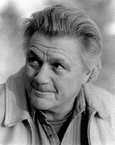 There is something different, something a tad experimental about John Irving's newest novel, The Fourth Hand.
Yes, the book offers the familiar pleasures of any John Irving novel -- a well-turned plot, an antic mixture of comedy and tragedy, and profound observations about the wounds and consolations of romantic and sexual love, to name just three.
But the feel of The Fourth Hand -- its heft, its pacing -- is noticeably different from previous John Irving novels. For one thing, it is only about half as long as earlier bestsellers such as A Widow for One Year or The World According to Garp.
"I don't think The Fourth Hand is experimental in any modern sense," Irving said during a recent call to his home in Vermont. "It is still essentially a linear novel, and it relies on narrative momentum to move it ahead. But this is my 10th novel, and it is only the second novel that I've written without a childhood. I don't give Patrick Wallingford or Mrs. Clausen a childhood. Those omissions were daunting to me. I always think that my feet are firmly on the ground as a novelist when I'm telling a whole life. It's hard to imagine a novel without the effects of the passage of time. That is an experiment for me. I don't allow more than five or six years of time to pass. So, yes, a major-minor character is missing, and that character is the passage of time."
It is an omission with a point, given the fact that Irving is both satirizing the lack of historical context in what currently passes for television news and examining the emptiness of the life of television journalist Patrick Wallingford.
 In the breathtaking first chapter, Wallingford, while on assignment in India, loses his hand to a circus lion when he instinctively turns to record the lion's roar and puts his hand too close to the cage. The footage of Wallingford's tragedy is broadcast again and again to millions around the world, and Wallingford becomes famous as the "disaster man" and the "lion guy." His obsession with replacing his missing hand coincides with the obsession of Dr. Nicholas Zajac, a Massachusetts surgeon who wants to perform the first hand-replacement surgery in the U.S. Neither Wallingford nor Zajac counts on the complicating presence of Mrs. Otto Clausen, who donates her dead husband's hand to Wallingford -- and then demands the right to visit the hand. Wallingford's emotionally difficult relationship with Mrs. Clausen moves him toward the transformation that is the ultimate point of the narrative.
"It mattered to me a great deal that Wallingford be extremely likable," Irving says. "I wanted him to be the kind of character that if you met him you couldn't help liking him. Despite his, shall we say, moral insufficiencies, he's not a bad guy. Yet there's this sort of irritating superficiality about him."
 Irving embodies Wallingford's superficiality -- and the superficiality of what the author refers to as "not-the-news network news" -- in a sort of featureless urban landscape. "My novels generally have a lot of landscape detail, a lot of atmosphere," Irving says. "Here I tried to make everything like television itself. There's a kind of sameness to everything. I consciously kept the opening chapters short and void of landscape, making the pace of the novel as quick as I could make it right up until Wallingford realizes that it's not the hand that he's missing, but an integral piece of his life, that he's met her [Mrs. Clausen] and she's gone away. From that moment on, not only do the chapters get longer, but the tone of the novel changes considerably."
From that moment on, Wallingford pursues Mrs. Clausen and grows increasingly discontented with his career as a television journalist. In the book and in conversation, Irving is sharply critical of television news. "How many times do we have to see Princess Di leaving the Ritz!" Irving exclaims at one point in our discussion. "It's not even a good shot; it's just the last one."
Wallingford's rude awakening arrives when he chooses to hide out and not cover the biggest story of the moment -- the John F. Kennedy Jr. plane crash. "I chose the Kennedy episode because there was nothing about him or his wife that bespoke a sought-after celebrity," Irving says. "He had it, but he never looked like he wanted it, so I felt that even in his death he was being violated. We all were. You walk away from the television set feeling disgusted with yourself that you have watched it again. Even at the end of four or five days, you've seen nothing new. You've heard nothing but vapid repetitions of homilies. It's all repetitious stuff. It's empty."
 Contrast that with how Irving feels about reading. "I know a lot more about adultery from reading Madame Bovary than from hearing about all the myriad divorces of my friends, which is to say the details are just a little better. I've learned a lot from reading novels, not only about how I want to write or to tell stories, but most of what I know about so-called experience. Maybe books don't get enough acknowledgement for their substitution in many people's lives for personal experience. The fact that something happened to me is of less interest to me than how well the tale is told. Personal experience is not all it's chalked up to be."
Little wonder then that books are part of the emotional currency of the characters in this and other Irving novels. Wallingford discovers, to his surprise, that Mrs. Clausen, who works in ticket sales for the Green Bay Packers, is reading The English Patient. He pursues her, ineptly, by trying to discuss the book with her.
 In such well-observed details, The Fourth Hand finds its emotional force. In fact, The Fourth Hand demonstrates again just how good John Irving is at dramatizing the positive and negative charges of familial love, especially the love of a father for a child. "I can't really separate being a writer from having children," Irving says. "I was an undergraduate when my eldest son was born. I was already a father with a young child when I was writing my first novel. When you're writing a novel you must impose a kind of solitariness. But you can't be alone with your thoughts without having your most pressing anxieties and concerns foremost in mind. If you have children, they are your most pressing anxiety and concern."
 Irving says that he has begun working on a new novel, a longer novel, a narrative that begins from the point of view of a four-year-old. But he is not yet completely done with The Fourth Hand. Working with Lasse Hallstrom and Richard Gladstein (the same team that made the movie of The Cider House Rules, for which Irving won an Academy Award), Irving will write the screenplay adaptation of the book. "I'm excited at the possibility," Irving says at the end of our conversation. "The story has two elements that I think will make it a good movie -- an immediate beginning and a good ending. If you've got that, you can't go too far wrong."
Alden Mudge writes from Oakland, California.