
| Paul Muldoon | |
| Interview by Gavin J. Grant |
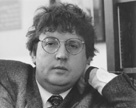 Paul Muldoon was born in Portadown, County Armagh, Northern Ireland in 1951. He lives with his family in New Jersey, and teaches at Princeton University. His first book of poetry, New Weather, was published by Faber & Faber in 1973. His latest book, Poems 1968 - 1998, will be published this month to coincide with National Poetry Month. We spoke to him by phone, New Jersey being far too far from Tarrytown, NY, for us to travel!
You're obviously not American, are you?
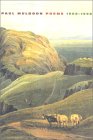 I was born in Northern Ireland in 1951. I lived most of my life there until 1986 or 1987. While I lived in Ireland I worked for BBC Radio -- and did a little bit of television at the end. When I came over to this country, I started teaching at various universities. I've been at Princeton most of the time. This book, Poems 1968 - 1998, is drawn from eight collections of poems that were published over those years.
Did you want to be a teacher when you were young?
Well my mother was a teacher, so there was always this sense that teaching is a noble calling, [Laughs] which I think it is. It's noble, it's also ennobling, in the sense it's very hard to be an inspiring teacher. I think that's what one is really aspiring to be, at least that's what I'm aiming to be. The teachers I had myself, the best of them were quite extraordinary, and really did inspire one into reading, or indeed, writing. It's a tall order, and I'm not sure I entirely made it, but it's certainly what I aim for.
What was having Seamus Heaney as a teacher like?
 James fell into that category of an inspiring teacher. He was my tutor for essentially one year at Queen's University in Belfast where he was teaching at the time. Then he came over to [the U.S.A.] to Berkeley. He was terrifically important, not only as a teacher, but also as an example. He was writing poems about a world that was very recognizable to me, being brought up 20 or 30 miles away. Which is actually a great distance in Northern Ireland, it's a very small place and the distances are paradoxically longer. But the fact that he was there, and writing, was very important to me, and to other people who were starting out at the time. He was always -- and continues to be -- very generous and helpful to other writers. Basically he's a great guy. Nice to see a good poet who is also a popular poet, and those two things don't always go together.
Why do think that although poetry is immensely popular it often doesn't translate into sales?
 I think that's so hard to judge. One is never sure just how popular it is. It certainly isn't reflected in sales for the most part. Yet there seems to be a lot of interest -- readings, and slams and all the rest of it. There are so many reasons underlying it. I'm not sure if I know all of them, or if I can really answer it, but I'll have a stab at a few of them. Part of it is it's never really been very popular in general. I think it has always been read by a smaller rather than a larger number of people. There have been exceptions along the way, people like Byron, Tennyson, and of course other more obvious examples from this century, like Rod McKuen, and indeed Seamus Heaney. They're exceptions, I think. For whatever reason, people, including very well-educated people or people otherwise interested in reading, do not read poetry. They have not kept up with the business of reading poetry since they've been in school, where, in many instances, it's been taught out of them. They've been put off particularly by so much 20th century poetry that was difficult. Teachers often took it upon themselves to show just how difficult it was, and that's not really something that encourages something that encourages people to read. Your average pop song or film is a very sophisticated item, with very sophisticated ways of listening and viewing that we have not really consciously developed over the years -- because we were having such a good time. We simply have not kept in touch with poetry. One reads all sorts of dead giveaways: like people who that say, "I remember the days when poetry used to rhyme, that was the kind of poetry I liked." They obviously haven't looked at a book since they went to school. It's a strange business, it's very hard to take account of it. The other side of it is that, despite all that, people reach out to poetry at the key moments in their lives. The moments of great emotional upheaval. When people have children, get married, when they have a funeral, they start looking around for a poem for the occasion. It's not that it doesn't mean something to them.
Poetry is not being taught to the extent it used to be -- and various aspects of memorizing poetry are not being taught. It's hard to find a single reason to account for it.
Your poetry seems to be written to be read aloud. Do you do many readings?
 Certainly as I'm writing it I'm conscious of its speakability, as it were. Nothing, I suppose, or at least, not very much, can't be spoken aloud. I certainly am interested in accessibility, clarity, and immediacy. A lot of it is very available. Some of it is a little bit more difficult. I'm sure there are people who would say, "He must be crazy if he thinks it's all not quite difficult." Some of it is a little more complex than others. Not because I set out to make it difficult, but because it's -- I hope appropriately -- complexity is equal to where we are, how we are. Just being here is a complex business.
Do you enjoy readings?
I do a lot of readings. Do I enjoy it? I don't think too much about it. If I think too much about it I'd probably get a bit nervous. I basically try to read poems as if it were the first time. It's an act of criticism in a way, and performance; an interpretive act.
Do you like living in the USA?
I do very much. I've lived in various parts of the country. I live in New Jersey now, which always gets a bad rap here and there, but I must say, I enjoy living here too. I enjoy doing what I do -- teaching.
What do you miss about Ireland?
I miss various people there, but, of course, none of them come over! I actually go back there a great deal myself. Last year, for example, I'm sure I was back there half-a-dozen times. I always go to England quite a bit, at least three times a year, because I have this honorary appointment at Oxford now.
Are you enjoying being Professor of Poetry at Oxford?
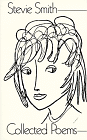
 That's pretty demanding. I give three lectures a year there. I find that quite hard to do. I enjoy it but it's always there hanging over me. The last lecture was on a poem by Emily Dickinson. In each instance I read a single poem, so over the five-year period -- if I see the end of it! -- I'll have read quite a wide-ranging number of poets. So far I've looked at poems by Yeats, Ted Hughes, Robert Frost, Elizabeth Bishop, Emily Dickinson, and the next one is a poem by Stevie Smith. She was born in Hull and she's not quite so well known. She wrote a novel called Novel on Yellow Paper. "Not Waving, But Drowning," is probably her best-known poem.
So you're doing a wide range of poetry?
I sat down and devised a series title for the lectures, which is "The End of the Poem" -- thinking about various ways of reading that phrase. I remember meeting Seamus Heaney once, he was also Professor of Poetry at one stage, and I could see that he was thinking about what he was going to do next. I knew this would be hard enough to do without actually having to worry about what I would be speaking on, so I sat down early on and tried to work out a plan, which I've stuck to. It takes up a lot of my energy, but I still find the time to read the odd poem.
What poets do you read?
I read virtually everything, certainly by the obvious candidates, published in this country and across the water. A lot of it is sent to me. I keep in touch with most of what's going on. Although I read some fiction, I don't even try to keep in touch with it! I'm interested in poets from all over the place and from all eras. [There are] certain major heroes like Robert Frost and John Dunne. They're probably the two big poets for me. The ones who had the most impact on me.
Do you get a chance to read for pleasure?
Well, right now that's a good question! Is it for pleasure? It is! Sometimes it's not entirely pleasurable, in the sense that I'm interested in poetry that's provocative, and it's not necessarily a salve, or pleasant to read. That's disturbing in some ways. Last year I was a judge for a prize in England, the T.S. Eliot Prize, so I read everything that was published in England last year. Which was not actually as much as you might imagine, there were only 70 or 80 books of poetry published in the UK -- at least that came to us. So it's not such a tall order as I'd imagined. I think there are years in which there are more books than that.
Do you have a good local bookshop?
Absolutely! I buy pretty much everything from Micawber's (1) on Nassau Street in Princeton. It's quite a wonderful bookstore. The man who runs it is called Logan Fox, he's got spectacularly good taste, as far as I'm concerned. Since it coincides with mine, I naturally think it's spectacularly good. It's the sort of place you go in and want to read everything that's in there. I think that's one of the marks of a good bookstore. You can see an intelligence at work in the person who is buying the books. I'm delighted to be doing a little bit of a launch for Poems 1968 - 1998 in Micawber's on Thursday the 19th of April at 5.30pm.
(1) Micawbers. 110 Nassau Street, Princeton, NJ 08542 609-921-8454 http://www.micawber.com

Author photo by Robin Hiteshew.