
| Mouthwatering Fiction by Sergio Troncoso |
 I was born and grew up in Ysleta, a poor colonia on the eastern outskirts of El Paso, Texas. When my father and mother built their own adobe home on San Lorenzo Street, we used kerosene lamps and stoves because we had no electricity yet. We dug a hole in the backyard and built a small shack for an outhouse.
Imagine growing up like that with parents who love you. Imagine learning the meaning of hard work and straight talk in Ysleta, and then attending Harvard and Yale and finding out these storied places could learn a lot about moral character by understanding your old neighborhood. Imagine reading book after book of "American literature," and finding out you hardly exist at all -- you, a Chicano from the Mexican-American border. Imagine that you read Chicano literature, and you finally find yourself in stories, but imagine that you are still not satisfied.
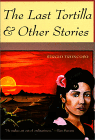
 Chicanos, poor Chicanos, discuss ideas. They struggle with moral questions. They are more than just the colorful caricatures so easily accepted as true by even the well-intentioned media. Chicanos have minds. Imagine that you hear other Chicano writers say, "I write life as it is" to explain, feebly, why they don't discuss ideas in their stories. As if they never had an abuelita who, over a cup of coffee in her small apartment in El Segundo Barrio, argued passionately about death and God and the purpose of life. "Life as it is," for me, meant a grandmother who philosophized with the best of 'em, although she never finished more than three years of school. Imagine having such a wonderful abuelita, and you will understand why I started writing The Last Tortilla and Other Stories.
I say "imagine this" because I know many of my readers will never visit, much less live in, Ysleta. They may see a poor desert community on the Mexican-American border, and rely on Hollywood images or other distorted depictions of these viejitos and niños and familias. And of course, it is not that I have written sentimental stories to provide you with just another equally distorted set of images. Witness the brutality of Lupe Perez's life, in "Day of the Dead," as she crosses the Río Grande everyday to work as a maid. Experience how a 12-year-old boy endures the awful pain of his first day of work, carrying live chickens from trucks to cages in a warehouse.
 Sometimes these characters win their battles, and sometimes they don't. Sometimes, like Tuyi, the fat boy everybody ignored in "The Snake," they win, unwittingly, and just want to be left alone. "Imagine this" means to open your eyes, to be curious again, to lift that leaden veil from how you might usually see a place like Ysleta. "Imagine this" is nothing short of a challenge to free yourself from the limitations and prejudices of your own perspective.
Whenever I return to Ysleta to visit my parents and brothers who still live there, I always do two things, sometimes in one late morning drive before it's too hot outside: I buy asaderos, succulent thin pancakes of salty and tangy cheese, from Licon's Dairy. You can put an asadero on a hot tortilla, but I eat 'em straight up, before I even pull out of the dairy onto the farm road. I know, I sound like a travel guide, but if you had just once tasted a warm, fresh asadero, you'd be sucking back the saliva, too.
 After the asaderos are next to me on the front seat, I stop in at The Bookery,* which has the best collection of Latino literature in El Paso. It's on Socorro Road, the same road as Licon's Dairy, and right next to the historic Socorro Mission. Margaret Barber has her bookshop in an old, crumbling adobe building -- which of course has no sign on Socorro Road, not one inkling that you are rumbling by one of the literary treats of the Southwest. I have given several readings at The Bookery, and when my friends and neighbors showed en masse, one after another said they'd driven by this turn on Socorro Road for years without ever noticing this grotto chock-full of book after splendid book. Margaret, put up a sign!
Some of my favorite books are Rudolfo Anaya's classic, Bless Me, Ultima; Rolando Hinojosa's The Useless Servants; and Dagoberto Gilb's The Magic of Blood.
There is a great culture on la frontera, in places like Ysleta. On this border between Mexico and the United States, another America is commonplace -- one in which most people are bilingual in Spanish and English, where it is routine to travel between two cultures, a place where this third culture has been formed, on a fault line, with bridges, and the good and bad therein. I hope you will open your eyes and imagine a placelike Ysleta.
* The Bookery 10167 Socorro Road Socorro, TX 79927 (915) 859-6132
The Last Tortilla and Other Stories
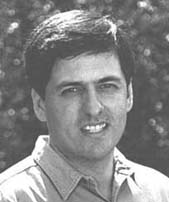 Sergio Troncoso received a Fulbright scholarship to study in Mexico City where he studied Mexico and Latin America. Later he mixed studying philosophy with working as a labor economist. Now he writes and teaches fiction writing. He is a member of the board of directors of the Hudson Valley Writers' Center. The Last Tortilla and Other Stories won the Premio Aztlan, for the best book of fiction by a new Chicano writer, and the Southwest Book Award from the Border Regional Library Association.